
The European Federation of Geologists (EFG) is pleased to announce the establishment of three new Working Groups dedicated to Soil, Natural Hazards and Radioactive Materials.
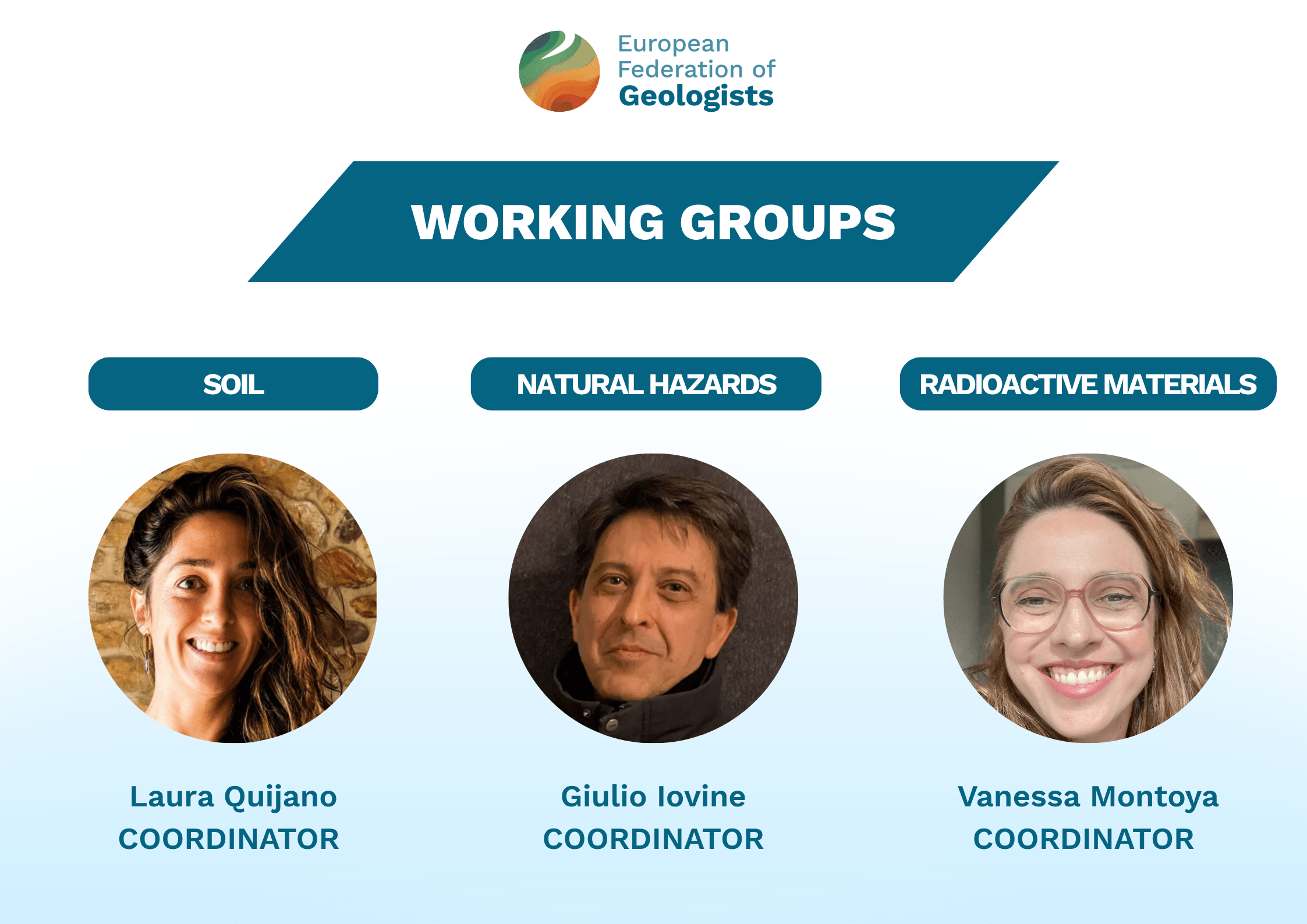
The new groups replace the former Panels of Experts covering these thematic areas and form part of EFG’s ongoing evolution of its expert structures. The transition follows a decision taken by the EFG Council in Zaragoza in November 2025 to introduce topic-oriented Working Groups designed to enable greater flexibility, responsiveness and cross-cutting collaboration.
Bringing together geoscientists and other specialists from across Europe, the Working Groups will provide EFG with dedicated platforms for knowledge exchange, professional cooperation and evidence-based contributions to European policy and practice. Their work will also reinforce the role of geoscience in addressing some of Europe’s most pressing environmental and societal challenges.
Working Group on Radioactive Materials
The Working Group on Radioactive Materials provides a European platform for geoscientific expertise supporting the safe, sustainable and climate-resilient management of radioactive materials throughout their lifecycle.
Its scope extends across radioactive materials arising from energy production, medicine, research, industry, legacy contamination and naturally occurring sources. Rather than approaching the topic exclusively as a waste-management issue, the group considers the full spectrum of radioactive materials, including naturally occurring radioactive materials (NORM), and their relevance to sectors such as mining, critical raw materials, geothermal energy, oil and gas, fertiliser production and water treatment.
By bringing together expertise from academia, industry, regulators, public authorities and research organisations, the group will support interdisciplinary collaboration, monitor European policy and regulatory developments and provide independent, evidence-based geoscientific input.
The Working Group is coordinated by Dr Vanessa Montoya, a geochemist and innovation manager with more than 20 years of international experience in research, academia and consultancy. Her work spans radioactive waste management, environmental remediation, circular economy, digitalisation and sustainable resource management.
Read more: https://eurogeologists.eu/panels-of-experts/radioactive-waste/
Working Group on Soil
The Working Group on Soil will promote the protection, sustainable management and restoration of soils as strategic natural capital supporting environmental resilience, food and water security, climate action, biodiversity and societal well-being.
Soils form a complex interface between geological materials, water, air, living organisms and human activity, providing essential ecosystem services ranging from food production and water regulation to carbon storage, pollution control and erosion prevention. At the same time, European soils face increasing pressures from erosion, contamination, sealing, compaction, salinisation, biodiversity loss, climate change and unsustainable land use.
Against the backdrop of a rapidly evolving European policy framework on soil health, the Working Group will connect geoscientific expertise with soil science, environmental management, digital technologies and policy. It aims to support evidence-based policymaking, foster professional collaboration and promote innovation in soil monitoring, assessment and restoration.
The group is coordinated by Dr Laura Quijano Gaudes, a geologist and soil scientist with extensive experience in European research and innovation, EU-funded project management and international scientific cooperation.
Read more: https://eurogeologists.eu/panels-of-experts/soil/
Working Group on Natural Hazards
The Working Group on Natural Hazards will strengthen the role of geoscience in understanding, assessing, mitigating and communicating natural hazard and disaster risks across Europe.
Its mission places a strong emphasis on moving from reactive emergency response towards proactive prevention and long-term risk reduction. The group will address geological and climate-related hazards including earthquakes, landslides, floods, droughts, volcanic eruptions, tsunamis, wildfires, coastal erosion and other interconnected and cascading risks.
Through its activities, the group will contribute to policy and advocacy, scientific innovation, capacity building and professional standards. Particular attention will be given to improving risk knowledge, preparedness and early warning, supporting climate adaptation and resilient infrastructure, developing harmonised approaches and promoting responsible applications of emerging technologies.
The Working Group is coordinated by Dr Giulio Iovine, Senior Scientist at the National Research Council of Italy, whose extensive research experience covers the monitoring, modelling, assessment and mitigation of geo-hydrological hazards.
Read more here: https://eurogeologists.eu/panels-of-experts/natural-hazards/
Strengthening EFG’s expert community
The establishment of the three Working Groups creates new opportunities to connect expertise from across EFG’s network and strengthen the contribution of professional geoscientists to European policy, research and practice.
Working Group members will contribute to activities including policy monitoring, position papers and technical recommendations, knowledge exchange, workshops and events, collaboration with European and international stakeholders and the development of initiatives aligned with EFG’s strategic priorities.
Together, the Working Groups on Natural Hazards, Soil and Radioactive Materials will help ensure that independent geoscientific expertise continues to inform solutions for a safer, more resilient and sustainable Europe.
Find out more about EFG’s expert groups and their activities: https://eurogeologists.eu/panels-of-experts/
