
European Geologist Journal 61
Financial Opportunities in the Raw Materials Sector of the European Institute of Innovation and Technology and the Role of the Southern Spain Innovation Hub
by Diana Patricia Fernández del Campo1, Manuel Regueiro y González-Barros2
1 CSIC Delegation in Andalusia and Extremadura Av. de María Luisa s/n, Casco Antiguo, Seville, Spain
2 Vice-Presidency for International Affairs of CSIC, C/ del Pinar 25, Madrid, Spain
* Corresponding author: diana.fernandez@csic.es
Abstract
EIT RawMaterials is leading the European innovation community in raw materials, it drives advancements in the minerals, metals, and materials sectors by promoting collaboration between industry, research institutions, and academia. Since 2016, the CSIC has been part of the Southern Co-Location Center and, since 2021, has taken on the coordination of the Southern Spain Innovation Hub. Its main objective is strengthening Spain’s Raw Materials sector by disseminating funding calls to the widest possible audience, fostering synergies among knowledge triangle members, and providing support to applicants regarding EIT RawMaterials calls. Over the years, it has provided guidance to numerous mining companies, start-ups, and universities, facilitated the formation of multiple consortia and collaborative initiatives, and has secured €1.4 million in funding.
Keywords
Regional Innovation Scheme, EIT RawMaterials, Funding calls, Mining, Southern Spain Innovation Hub
Cite as: Fernández del Campo, D. P.& Regueiro y González-Barros, M. (2026). Financial Opportunities in the Raw Materials Sector of the European Institute of Innovation and Technology and the Role of the Southern Spain Innovation Hub. European Geologist, (61). https://doi.org/10.5281/zenodo.21869851
Note:
Papers published in this special issue of the European Geologist journal have undergone a thorough peer-review process but have not been copy-edited. Authors bear full responsibility for the linguistic accuracy of their contributions.
 This work is licensed under a Creative Commons Attribution 4.0 International License.
1. Introduction
In recent years, access to mineral raw materials has become a key factor for reducing emissions, electrifying the economy, and supporting technological development in the European Union. Recent works warn of the growing dependence of Europe on elements like lithium and cobalt for batteries, or rare earth elements (REEs) also emphasize the system’s vulnerability to potential supply disruptions [1]. Any changes in how global mineral raw material value chains are organized or operate can significantly impact current socio-economic development [2].
At the same time, various studies have shown that, although Europe possesses significant deposits of critical minerals, limitations related to land use and availability, national legislation, and social acceptance hinder the development of these resources [3]. Altogether, these factors contribute to a landscape marked by uncertainty, international competition for strategic resources, and the need to strengthen European industrial autonomy [4].
In this context, European entities such as EIT RawMaterials play a key role by providing funding instruments and support that enable companies, research centers, and universities to develop innovative solutions across the entire raw materials value chain. Based on this, the aim of this article is to present the activities of the Southern Spain Innovation Hub, analyse the main support schemes offered by EIT RawMaterials, with particular focus on the KAVA and Booster-ERMA calls, and to present success stories that illustrate their impact on the sector. The KAVA calls provide funding for Technology Upscaling, Innovation, and Capacity-Building projects, helping to bring innovative technologies to the market and strengthen the sector’s resilience. In addition, the Booster-ERMA call offers funding to start-ups and SMEs that deliver sustainable solutions with a clear market orientation.
2. Materials and Methods
This study adopts an exploratory qualitative approach aimed at gaining an in-depth understanding of the activities of the Southern Spain Innovation Hub and the funding instruments facilitated through EIT RawMaterials, combining theoretical analysis with empirical insights from relevant experiences. To this end, two complementary methodological strategies were integrated: 1) the review of secondary sources (academic literature, press articles, and funding calls), and 2) In particular, the MIN-PET and BETOLAR projects, both funded through EIT RawMaterials calls, were examined as illustrative case studies.
3. Funding Opportunities
EIT RawMaterials operates in more than 25 countries (Fig.1) and brings together a network of over 300 partners, including universities, research centers, and companies. Since its launch, the community has mobilized substantial investments to transform ideas into market-ready solutions: more than €700 million invested since 2016, with annual investments typically ranging between €80–90 million [5]. These resources are combined with return models (income-sharing, equity, or hybrid approaches) that enable reinvestment in the community once the supported technologies reach the market.

Figure 1: EIT RawMaterials presence in Europe. Source: EIT RawMaterials, 2021.
The EIT RawMaterials Southern Innovation Hub acts as the local contact point of the EIT in Spain, with the primary goal of strengthening the region’s innovation ecosystem. Its main functions include promoting participation in EIT calls, providing guidance in proposal preparation, facilitating access to the partner network, and supporting the internationalization of projects and companies.
Within the wider European framework for innovation and sustainability in the raw materials sector, EIT RawMaterials plays a key role as a Knowledge and Innovation Community (KIC). Through its various funding schemes, the organization supports projects focused on technological development, specialized education, and the creation of new ventures in the field of mineral resources. The main funding calls promoted by EIT RawMaterials that can drive innovation in this sector are concentrated in two programmes: the KAVA calls and the Booster–ERMA all.
The objective of the KAVA calls is to support collaborative projects that address key challenges in the raw materials sector. These calls represent a strategic opportunity for companies, research centers, and educational institutions linked to the raw materials value chain, particularly in areas related to the green transition, process efficiency, and resource valorization. The call is structured around three main funding lines, as shown in the following table.
Table 1: Main KAVA 13 funding lines.
| Funding Line | Goals | Technology Readiness Level (TRL) | Funding | Co-funding |
| Upscaling | Finance technological scaling-up projects to boost the commercialisation of innovative products or services related to the raw materials value chain. |
Minimum TRL at start: 5 Minimum TRL at end: 8 |
Up to €2,500,000 per project. | 30% |
|
RIS Capacity Building |
Strengthen innovation capacity in the Regional Innovation Scheme (RIS) countries, promoting knowledge transfer and fostering the participation of local actors in the sector. | Minimum TRL at start: 4 | Between €400,000 and €600,000 per year (project duration: 1–2 years). | 10% |
| RIS Innovation | Accelerate the market entry of technologies, products, or services developed in RIS regions. |
Minimum TRL at start: 6 Minimum TRL at end: 8 |
Between €500,000 and €1,000,000 per project. | 20% |
On the other hand, the Booster-ERMA Call acceleration programme of the European Raw Materials Alliance (ERMA) aims to strengthen Europe’s resilience and strategic autonomy in the supply of critical and strategic raw materials. It targets projects that directly contribute to reinforcing European value chains, particularly in relation to the exploration, extraction, processing, recycling, and substitution of critical and strategic raw materials [6].
The thematic areas eligible for funding under both support lines include new processing technologies, recycling, environmental impact mitigation, the valorisation of construction and demolition waste, and improvements in energy efficiency in the extraction and processing of materials, among other relevant topics (Fig. 2).
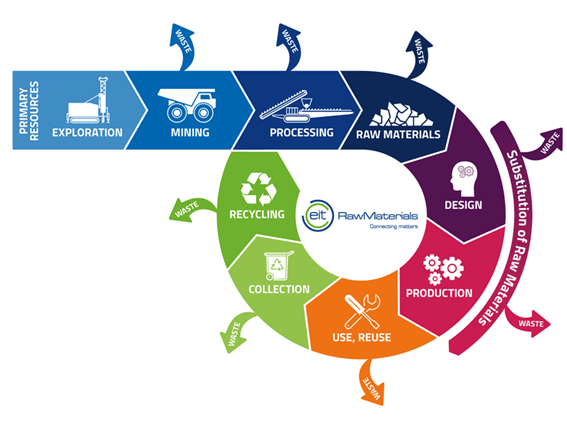
Figure 2: Raw Materials Value Chain. Source: EIT RawMaterials, 2021.
These funding lines provide direct financial support to SMEs, start-ups, research centres, and academic institutions, as well as access to the value-added services offered by EIT RawMaterials. Priority is given to initiatives that can demonstrate a tangible contribution to European strategic autonomy in raw materials and that are aligned with the objectives of the European Critical Raw Materials Act [7]. These calls represent a strategic opportunity to advance innovative projects that promote more efficient and sustainable mining practices, fully aligned with the green and digital transition goals set by the European Union.
The Southern Spain Innovation Hub plays a central role in disseminating and facilitating access to these funding opportunities at the regional level. It engages with relevant stakeholders through targeted communications, workshops, and information sessions, providing guidance on eligibility criteria, proposal preparation, and partnership formation. In this way, the Hub fosters collaborative networks among companies, research centres, and universities, enhancing the effectiveness and strategic impact of projects supported by EIT RawMaterials.
4. Success stories in Europe
Following the previous discussion and in line with the objective of this work, the following section analyses success cases in the raw materials sector based on innovative solutions financed through the funding schemes offered by EIT RawMaterials.
4.1 MIN-PET Project
The MIN-PET project (2016–2019), funded by EIT RawMaterials, is a notable example of circular-economy innovation applied to industrial by-products. The project succeeded in valorising a mineral residue known as Petrit-T, transforming it into functional raw materials for the manufacture of construction products, enabling the production of cement concrete, thermal insulation materials, and low-temperature ceramics [8].
This solution not only reduces the dependence on virgin raw materials but also contributes significantly to the decarbonisation of the sector. The Swedish company Höganäs has incorporated this technology into its production processes, reusing 80% of its industrial waste in 2019 and aiming to reach 95% by 2026, representing a substantial step forward in terms of sustainability and energy efficiency. Taken together, these efforts have demonstrated that a significant portion of the nearly 60 million tonnes of inorganic industrial waste generated annually in the EU can be given a second life, according to the [9].
4.2 Start-up Betolar
Betolar is a Finnish start-up that has developed Geoprime™, an innovative solution that replaces cement in concrete production by utilising industrial secondary streams, such as blast furnace slags and mining residues. This technology enables a reduction of up to 80% in CO₂ emissions during concrete production and decreases the use of primary resources, promoting a circular economy model within the construction industry and diminishing the need for the quarrying of aggregates [10].
Thanks to support from EIT RawMaterials through the Booster-ERMA call, Betolar has been able to validate and scale its solution, collaborating with companies such as JA-KO Betoni at the Keliber lithium mine in Kaustinen, Finland. There, they have leveraged secondary streams generated by mining to produce low-carbon concrete. Additionally, the company secured a €7 million investment from the Finnish Climate Fund to develop an AI-based digital platform that connects concrete manufacturers with suppliers of industrial secondary streams, facilitating the adoption of sustainable solutions in construction [11]. Betolar is leading the transition towards more sustainable and circular construction, demonstrating how technological innovation can significantly reduce the environmental impact of the construction industry.
5. Conclusion
The funding lines offered by EIT RawMaterials, particularly the KAVA and Booster-ERMA calls, represent key instruments for supporting research, technological development, and the commercialisation of innovative solutions in the raw materials sector. The success cases analysed demonstrate how these schemes foster the adoption of cutting-edge technologies which not only enhance the competitiveness of European companies but also address environmental and climate commitments. These innovations enhance the competitiveness of European companies while contributing significantly to environmental sustainability, resource efficiency, and the reduction of CO₂ emissions.
The Southern Spain Innovation Hub acts as a key connector between regional ecosystems and European opportunities, facilitating consortium building and fostering market-oriented innovation. Through this role, it supports initiatives in transforming research ideas into scalable, market-ready solutions. As a result, it makes a substantial contribution to accelerating both the technological and industrial transition of the raw materials sector, in alignment with the objectives of the European Green Deal.
References
- Montana, F., Cellura, M., Di Silvestre, M. L., Longo, S., Luu, L. Q., Riva Sanseverino, E., & Sciumè, G. (2025). Assessing Critical Raw Materials and Their Supply Risk in Energy Technologies—A Literature Review. Energies, 18(1), 86. https://doi.org/10.3390/en18010086
- Mateus, A., & Martins, L. (2021). Building a mineral-based value chain in Europe: The balance between social acceptance and secure supply. Mineral Economics, 34, 239–261. https://doi.org/10.1007/s13563-020-00242-3
- European Parliament & Council of the European Union. (2024). Regulation (EU) 2024/1252 establishing a framework for ensuring a secure and sustainable supply of critical raw materials. Official Journal of the European Union, L 2024/1252. https://eur-lex.europa.eu/legal-content/EN/TXT/PDF/?uri=OJ:L_202401252
- Jakimów,M., Samokhalov, V. & Baldassarre, B. (2024) Achieving European Union strategic autonomy: circularity in critical raw materials value chains, International Affairs, Volume 100, Issue 4, July 2024, Pages 1735–1748, https://doi.org/10.1093/ia/iiae127
- European Institute of Innovation and Technology (EIT) (2021). EIT RawMaterials Strategic Agenda 2021–2027. Retrieved from https://eitrawmaterials.eu/sites/default/files/2024-11/EIT_RM_Strategic_Agenda_2021-2027.pdf. Accessed on 2 December 2025.
- European Institute of Innovation and Technology (EIT) (2025). ERMA Booster Call https://eitrawmaterials.eu/erma-booster-call Accessed on 30 January 2026.
- European Commission. (2024). Critical Raw Materials Act., from https://single-market-economy.ec.europa.eu/sectors/raw-materials/areas-specific-interest/critical-raw-materials/critical-raw-materials-act_en. Accessed on 2 December 2025.
- Höganäs (2022). Petrit® T and Petrit® T-S – By-product that can replace lime and coal. https://www.hoganas.com/sv/powder-technologies/biprodukter/alternativ-till-kalk-och-kol/. Accessed on 1 December 2025.
- European Institute of Innovation and Technology (EIT) (2020). EITRawMaterials: Cerrando el ciclo de materiales con Petrit-T: convirtiendo los flujos secundarios industriales en paneles acústicos y cemento. https://www.eit.europa.eu/news-events/news/eit-rawmaterials-closing-material-loops-petrit-t-turning-industrial-side-streams. Accessed on 1 December 2025.
- Betolar (2023) Geoprime™: Sustainable concrete solutions. https://www.betolar.com/. Accessed on 1 December 2025.
- European Institute of Innovation and Technology (EIT) (2022). Betolar tiene la misión de impactar toda la cadena de valor de la industria de la construcción. https://www.eit.europa.eu/news-events/success-stories/betolar. Accessed on 1 December 2025.
This article has been published in European Geologist journal 61 – 5th IPGC Special Edition 2
