
The European Federation of Geologists (EFG) and the Pan-European Reserves & Resources Reporting Committee (PERC) were glad to co-organise the international conference “MIN WIN‐WIN: Establishing Europe‐wide minerals reporting standards – the key to reducing risk and increasing opportunity” from 20 to 21 November 2014 in Brussels. This two-day event was held at the Royal Belgian Institute of Natural Sciences, a privileged venue located in immediate proximity of the European Parliament, and was supported by a broad range of organisations active in the field of minerals and mining.
The continuing rise in global population and living standards, as well as technological innovation, is leading to increasing requirements for a broader range of metals, minerals and other raw materials. EU manufacturing and improved positioning of EU enterprises in the global value chain is currently dependent, to great extent, on imports of mineral raw materials from outside Europe. This dependency is associated with the contraction of primary mining activity in the EU over several decades, driven by lower production costs outside the EU and pressures to protect the natural environment within the EU. Increasingly, EU supply chains for raw materials are adversely affected by growing demand pressure from emerging economies and by an increasing number of restrictive national policy measures that impact the normal operation of supply chains. This dependence on supplies that are largely beyond EU control threatens the security of raw materials supply, but also highlights opportunities for expanding primary extraction and recycling within the EU, in line with sustainable development objectives. In this context, the European Commission launched the European Raw Materials Initiative (RMI) in 2008 in order to stabilize long‐term commodity prices by removing market distortions, to provide alternative approaches to meet demand, and to support the transition to a low carbon and resource‐efficient economy.
In this context, the conference’s main aim was to promote the adoption of a common reporting standard in the EU to be used both by the industry and by governments and European Community entities. Such an approach is intended to contribute to the convergence of terminology and the comparability/compatibility of data, thus facilitating the creation of a solid European Knowledge Database on mineral resources and to the successful delivery of the Raw Materials Initiative.
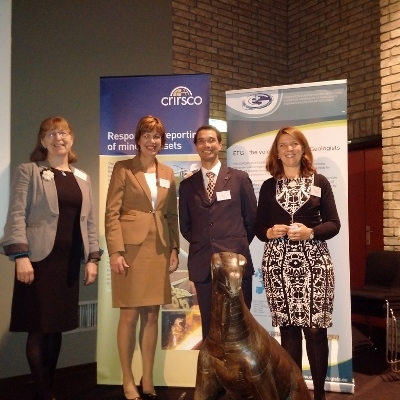
Providing the audience with a unique opportunity to learn about and discuss concrete steps regarding mineral reporting in a cross-disciplinary environment, the conference was attended by more than 100 participants including EU policy makers, national government officials, academics, minerals company executives, consultants, finance and industry experts. The organisers were particularly pleased with the presence of several keynote speakers from the European Institutions, the World Bank and leading geosciences organisations.
During the first session that familiarised the audience with the framework of current EU policy on Raw Materials, Reinhard Bütikofer, Member of the European Parliament and representative of the German Green party (die Grünen) underlined the crucial necessity for Europe to develop a common Raw Materials Policy, required, as he explained, by a decisive shift that has taken place over the past years in the balance of global economic power linked with the emergence of several new players such as China, Brazil and India. In the context of recent changes in global consumption and life style patterns that are reflected in intensification of international competition, a reliable supply of raw materials is becoming critical for Europe. Mr. Bütikofer therefore called upon the strengthening of cooperation at European level in the field of trade, domestic mining and technology efficiency; the innovation sector being particularly significant for the success of this approach. Bütikofer furthermore emphasized that Europe must be more ambitious in this field and that the input of geoscientists towards the European Parliament is most welcome in this matter.
In the second session that presented different information sources used for reporting across the EU, major industry representatives highlighted the importance of making quality data available for reporting purposes and clarified why the PERC standard – as the European member of the CRIRSCO reporting standards family – is so useful for the development of a common language for reporting in Europe.
On Friday morning the third session, dedicated to Dan Germiquet, former senior geologist of IMERYS and major representative of PERC deceased in 2013 in the Paris train crash, emphasized the existing discrepancies between national economic policies and governance structures in Europe and the opportunities offered by a common EU minerals knowledge database.
The main conclusions that can be drawn from the following sessions were summarised by Deborah McCombe during a panel discussion at the end of day two. Deborah McCombe, President, CEO and principal geologist at Roscoe Postle Associates Inc., and past Chair of CRIRSCO, highlighted in her concluding words the decisive role plaid by professional geoscientists. The main function of geoscientists as Competent Persons – with the relevant experience to give accurate estimates of resources and reserves, and the authority to approve market-sensitive reports – is thus to be useful, not only to investors and regulators, but principally to society. McCombe also stressed the need to avoid a language of conflict in discussions with regulators and investors, and to improve communication in general, and she emphasised that listening to the concerns of other interested parties is key to this role. She furthermore underlined the importance of disciplinary procedures: disqualifying or sanctioning any professionals who fail to meet the high standards required. She described the Canadian system in which the development of peer review processes within the geoscientists’ community allowed improvement in the quality of reporting.
The organisers and keynote speakers concurred that the broad recognition of the European PERC standard that is based on the international template provided by CRIRSCO, together with the improvement of communication between investors, regulators and industry, and the systematic involvement of Competent Persons for reporting, are crucial for winning the confidence of public institutions and society. Only a pan-European approach fully compatible with the international reporting template (CRIRSCO) and the United Nations Classification Framework (UNFC) may help European states in facing the challenges arising from globalisation and increasing raw materials scarcity. In this context, the European Federation of Geologists can play a major role by providing accreditation for qualified persons within its 24 member states.
About EFG: The European Federation of Geologists is a non-governmental organisation that was established in 1981 and includes today 24 national association members. EFG is a professional organisation whose main aims are to contribute to a safer and more sustainable use of the natural environment, to protect and inform the public and to promote a more responsible exploitation of natural resources. EFG’s members are National Associations whose principal objectives are based in similar aims. The guidelines to achieve these aims are the promotion of excellence in the application of geology and the creation of public awareness of the importance of geoscience for the society. www.eurogeologists.eu
About PERC: PERC is the organisation responsible for setting standards for public reporting of exploration results, mineral resources, and mineral reserves by companies listed on markets in Europe. It is a member of CRIRSCO, the Committee For Mineral Reserves International Reporting Standards, and the PERC Reporting Standard is fully aligned with the CRIRSCO Reporting Template. www.PERCstandard.eu
For more information please contact Isabel Fernández Fuentes (isabel.fernandez@eurogeologists.eu).
This event has been supported by: Committee for Mineral Reserves International Reporting Standards (CRIRSCO), Euromines, Geological Survey of Belgium – Royal Belgian Institute of Natural Sciences, Geological Society of London (GSL), Institute of Geologists of Ireland (IGI), Industrial Minerals Association (IMA), Institute of Materials, Minerals and Mining (IOM3), International Union of Geological Sciences (IUGS) Task Group on Global Geoscience Professionalism and United Nations Economic Commission for Europe (UNECE).
