
European Geologist Journal 52
Global assessment of soil pollution: The need for standardized methods
by Frank P.J. Lamé (1*), Klaus Liphard, Marleen Schoemaker (2) and Theresa Geßwein (3)
1 Deltares
2 NEN
3 DIN
Contact: frank.lame@deltares.nl
Abstract
Reliable analysis and quantification of components in soil is essential in order to determine if the soil is ‘fit for purpose’. Soil provides the basis for our existence, but not all soils can be used for every purpose. This is sometimes obvious, but often it is necessary to characterize the soil in order to identify what soil use is possible. For agricultural use, domestic housing, recreation or industries, just to mention a few, specific soil conditions apply and often governmental regulations are in place. Reliable characterization methods are therefore of major importance. Standardization of such reliable methods is the objective of the European standardization committee CEN/TC 444 – Environmental characterization of solid matrices and the worldwide standardization committee ISO/TC 190 – Soil quality.
Cite as: Lamé, Frank P.J., Liphard, Klaus, Schoemaker, Marleen, & Geßwein, Theresa. (2021). Global assessment of soil pollution: The need for standardized methods. European Geologist, 52. https://doi.org/10.5281/zenodo.5770142

This work is licensed under a Creative Commons Attribution 4.0 International License.
Introduction
The characterization of soil quality is essential in the assessment of its beneficial characteristics (e.g. for food production), but also to determine the potential adverse effects when confronted with polluted soil. Soil quality can be defined in term of its content of nutrients, (heavy) metals or chemical components, the potential leaching of these substances into ground and surface water, the availability for uptake by plants, animals and humans and in terms of the mobility of components and consequent distribution of these substances in the environment. Depending on the component and its concentration level and availability, it can either have positive or adverse effects on the soil quality. Characterization and assessment of soil quality is therefore important.
Providing reliable and well established international (ISO) and European (CEN) standards for the characterization of soil, is exactly the job of the technical committees ISO/TC 190 – Soil Quality and CEN/TC 444 – Environmental characterization of solid matrices.
The world of standardization
Standardization is a process of coming to a generally accepted agreement amongst stakeholders on a specific topic. Standardization is all around us, and facilitates many aspects of life. Standards allow markets for a specific product, while markets will lead to competition for best quality and lowest prices. One arbitrarily chosen example is hexagon head screws according to ISO 4017; if e.g. M10 screws are ordered from any manufacturer, they all will fit and have the same dimensions.
If no international standards are available, or national standards are not harmonized internationally, problems may occur. Everybody who has travelled abroad will know the problem of the variety of AC power plugs and sockets around the world. This can be solved by using adapters, but still, you need to be aware of the need to have the appropriate adapter with you.

Figure 1: Collection of travel adapters (photo by Klaus Liphard).
Standardization is a democratic and public process. As this process is quite complex, National Standardization Bodies (NSBs) support the work and organize web-based platforms for the exchange of information. NSBs are non-governmental registered organizations and are open to everyone.
The standardization process itself is performed by experts in the specific field, usually in a working group (WG). They discuss in what way reliable measurements can be performed and propose draft standards. These are published within the technical committee, and comments can be submitted by everyone via the NSBs. These comments are discussed in the WG – accepted or rejected – and at the end of a standardization process a standard is published after acceptance by a majority of voters in a final voting process amongst the participating NSBs. This process applies to all three levels at which standardization is organized: national, regional and worldwide.
The basis is the work on the national level, facilitated by the responsible NSB. Each country or territory has its own standardization body; see Table 1 for some examples.
Table 1: Examples of National Standard Bodies (NSBs) around the world (source: ISO website).
| Country/Territory | Acronym |
| Austria | ASI |
| Czech Republic | UNMZ |
| Canada | SCC |
| Germany | DIN |
| Japan | JISC |
| Korea (Republic of) | KATS |
| Netherlands | NEN |
| United Kingdom | BSI |
On the regional level there is sometimes a formal cooperation between NSBs, providing common standards for that region. An example is the European Committee for Standardization CEN, which provides European Standards (labelled ‘EN [number]’).
Finally, standardization at worldwide level runs through the International Standardization Organization (ISO). The outcome is International Standards (labelled ‘ISO [number]’). The NSBs nominate national experts to participate on both European and worldwide standardization levels. This article introduces the work of two technical committees working towards standardization related to soil: the ISO committee 190 and the European committee 444.
ISO/TC 190 – Soil Quality
In the 1980s, awareness regarding soil protection began to increase. While water and air react visibly faster to negative influences, soil can accumulate larger amounts without this being noticeable. Nevertheless, adverse effects are present and need to be detected by robust and sensitive methods.
For that purpose, the technical committee ISO/TC 190 – Soil Quality was established in 1985, and had its first meeting in The Hague (the Netherlands) in 1986. Currently, ISO/TC 190 has 28 actively participating members (NSBs) and 29 observing members (without the right to vote). It is currently made up of three subcommittees (SCs) with in total seventeen active working groups (WGs). The structure is depicted in Figure 2.
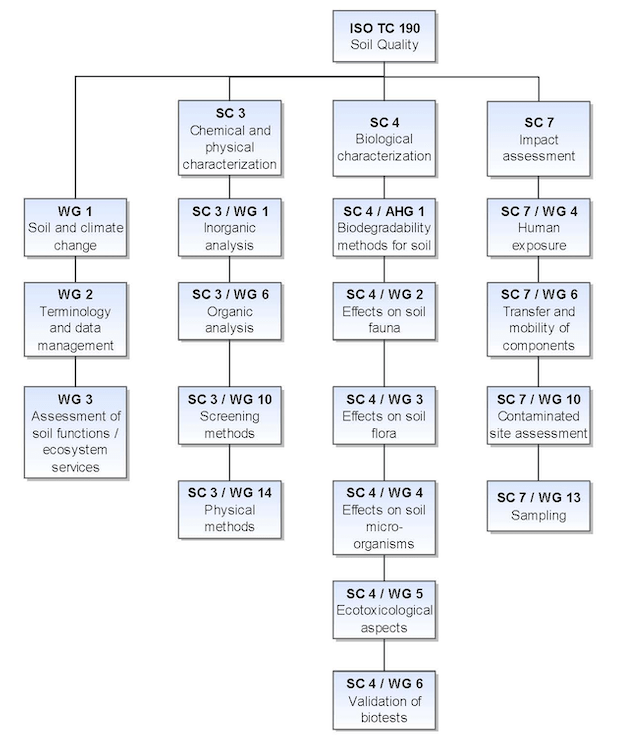
Figure 2: Structure of ISO/TC 190 – Soil Quality.
As of early September 2021 ISO/TC 190 has published – coincidently – 190 standards for the characterization of soil, while another 19 standards are under development. These standards cover a wide variety of topics, including the vocabulary, sampling, sample storage, transport and preservation, physical and biological characterization, the determination of both organic and inorganic components as well as leaching and assessment methods. Some recently published examples are provided in Table 2.
Table 2: Examples of recently published ISO standards under ISO/TC 190 – Soil quality.
| ISO number | Title |
| ISO 18400-101:2017 | Soil quality — Sampling — Part 101: Framework for the preparation and application of a sampling plan |
| ISO 15192:2021 | Soil and waste — Determination of Chromium(VI) in solid material by alkaline digestion and ion chromatography with spectrophotometric detection |
| ISO 23266:2020 | Soil quality — Test for measuring the inhibition of reproduction in oribatid mites (Oppia nitens) exposed to contaminants in soil |
| ISO 21365:2019 | Soil quality — Conceptual site models for potentially contaminated sites |
CEN/TC 444 – Environmental characterization of solid matrices
CEN/TC 444 – Environmental characterization of solid matrices was established in 2015, but unlike ISO/TC 190, it had a series of predecessors. Originally, the European field of environmental standardization was matrix oriented; there were separate technical committees (TCs) for soil and waste. However, from an analytical point of view the characterization methods for these matrices were quite similar. This was further investigated in the EU-funded project ‘Horizontal’, which resulted in the development of harmonized European standards for multiple matrices (sludge, treated biowaste and soil). To integrate the results of project ‘Horizontal’ into the CEN system, a temporary Project Committee was established (CEN/TC 400 – Project Committee – Horizontal standards in the fields of sludge, biowaste and soil), but with the end of project ‘Horizontal’ this Project Committee came to the end of its lifespan. At the same time, there was no TC that had a sufficiently large work area (sludge, biowaste and soil) to accommodate the standards that resulted from the project ‘Horizontal’. This, together with the awareness that the efficiency of the standardization process could be enhanced, resulted in the disbandment of three CEN technical committees: CEN/TC 400, CEN/TC 292 – Characterization of Waste and CEN/TC 345 – Characterization of soils. Standards from these three TCs were transferred to the newly established CEN/TC 444. Currently CEN/TC 444 has 21 actively participating members (NSBs) and 25 observing members (without the right to vote).
CEN/TC 444 and its predecessors have published 168 standards, while another 23 standards are still under development. Part of these standards are single-matrix standards that still need to be withdrawn as a result of the multi-matrix standard that resulted from project ‘Horizontal’. This is an ongoing process wherein the current state-of-the-art knowledge is included. However, it is important to note that not all standards within the working area of CEN/TC 444 are or can be multi-matrix standards. For example, even though the underlying principles are comparable, there are significant differences in the sampling of in situ soils and a stream of waste material. Therefore CEN/TC 444 accommodates both single- as well as multi-matrix standards.
Like ISO/TC 190, CEN/TC 444 has a wide variety of technical areas which are reflected in its organizational structure, as depicted in Figure 3.
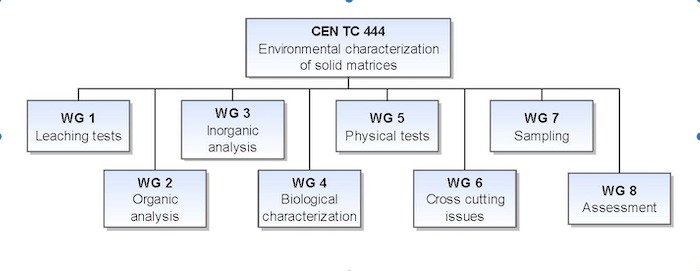
Figure 3: Structure of CEN/TC 444 – Environmental characterization of solid matrices.
Cooperation between ISO/TC 190 and CEN/TC 444
As the work area of CEN/TC 444 includes standards for soil, there is a strong relation with ISO/TC 190. In fact, a large number of standards that have been developed by ISO/TC 190 have been adopted as European standards.
As mentioned before, the matrix-orientated (vertical or sectoral) approach has been superseded by the multi-matrix (horizontal) approach. To ensure the best utilization of limited resources and to avoid duplicate work, ISO/TC 190 and CEN/TC 444 work closely together. Some multi-matrix standards are developed with ISO leading and CEN participation, for others it is vice versa. The result will be an EN ISO standard – an identical delivery in both organizations.
An example for an ISO-led process is the merger of two standards for the selection and application of screening methods. Originally a CEN method was developed for the application of screening methods for the swift characterization of waste materials. In parallel, a comparable ISO method was developed for soil. With the possibility to develop multi-matrix standards, this resulted in EN ISO 12404 ‘Soil and Waste — Guidance on the selection and application of screening methods’.
The corresponding example for a CEN-led process is the merger of two standards for the determination of elements by ICP/OES. Originally there was a CEN method for sludge, treated biowaste and soil, and an ISO method for soil. In a currently ongoing standardization effort, these two standards will be merged into a single EN ISO standard whose publication is scheduled for early 2023.
Fields of application of soil standards
As already mentioned in the introduction, soil characterization standards can be used in a large variety of different areas. The result of those measurements should not be a cause for dispute: they need to be reliable and fulfil the quality demands of the involved legislative framework. In such a situation, if legislative limits are exceeded, the discussion should be focused on the exceedance and not on the reliability of the method.
Contaminated areas can be a threat to the environment. This includes abandoned industrial sites, but also areas affected by airborne contaminants or flooding. Suspected contaminated areas need to be investigated in a multi-step approach including historical survey, sampling plan, sampling, analysis and assessment. The results have to be checked against governmentally set threshold and/or limit values. These results will be obtained by different methods for different purposes. This involves amongst others the total concentration of a specific compound in the soil, the amount of this compound that can leach into groundwater, or the oral intake by children on playgrounds.
In food and feed production, the quality of the agricultural soil plays an important role. On the one hand the farmer wants to maximize the crop production, but at the same time costs (e.g. for fertilizers) are to be limited while also the environment needs to be protected (e.g. protection against runoff from an excessive fertilizer load). But such decisions are not only up to the farmer. National and/or regional governments have adopted legislation to which the farmer has to comply, and this compliance can only be quantified through measurements.
Conclusions
Reliable results can only be obtained by reliable standardized methods. These methods are developed by national, regional and international organizations. Two technical committees, ISO/TC 190 – Soil Quality and CEN/TC 444 – Environmental characterization of solid matrices, play an important role in the characterization of soil. Their standards prove the validity of the slogan, “Once tested, accepted everywhere”.
For further reading
- International Standards Organization: http://www.iso.org
- List of ISO member National Standards Boards: https://www.iso.org/members.html
- ISO/TC 190: https://www.iso.org/committee/54328.html
- European Committee for Standardization: https://www.cencenelec.eu/
- CEN/TC 444: https://standards.cencenelec.eu/dyn/www/f?p=205:7:0::::FSP_ORG_ID:2046877&cs=1C379FCFCAAF69B55CD86BA254B8F2F7F
This article has been published in European Geologist Journal 52 – Soil – Our endangered food base
Read here the full issue:
