
European Geologist Journal 54
Public perceptions of geothermal projects: New ways of measuring and monitoring local acceptance and social impacts
by Jan Hildebrand 1*, Alena Jahns 1, Lea Schwarz 1 and Amel Barich 2
1 Institute for Future Energy and Material Flow Systems (IZES)
2 Geothermal Research Cluster (GEORG)
Contact: hildebrand@izes.de
Abstract
For a successful energy transition, the deployment of renewable energy sources like geothermal is a fundamental step towards a sustainable power and heat production. In this context, public acceptance towards such energy projects is a crucial factor for both the number of realised projects and the speed of their realisation. Based on empirical work, the paper discusses the factors relevant for the acceptance of geothermal projects and provides an insight into new approaches for measuring acceptance and social impacts connected with geothermal projects within the conceptual frame of social license to operate. The presented approach serves as a guiding tool for public engagement as well as an instrument for monitoring acceptance and social impacts. Therefore, the paper feeds both the scientific discourse and practical applications.
Cite as: Hildebrand, Jan, Jahns, Alena, Schwarz, Lea, & Barich, Amel. (2022). Public perceptions of Geothermal Projects – new ways of measuring and monitoring local acceptance and social impacts. European Geologist, 54. https://doi.org/10.5281/zenodo.7602374

This work is licensed under a Creative Commons Attribution 4.0 International License.
1. Introduction
The development of new energy infrastructural projects such as geothermal energy projects ought to be observed under the perspective of a sociotechnical system approach, which means that each installed technological object is not just a technical matter, but rather very much a question of social and economic change with impact on people’s everyday lives regarding energy production, distribution and consumption. In this context, the various renewable energy projects also repeatedly have had to contend with acceptance problems at the local level during recent decades. Many studies show a wide range of different acceptance factors that are relevant in this context: changes to the landscape, fear of negative effects on the environment, nature or one’s own health, and planning and approval procedures that are experienced as unfair or non-transparent [1]. In the context of deep geothermal plants, fear of earthquakes triggered by drilling is also a specific acceptance factor [2]. In the past, there have been several studies on the acceptance of geothermal energy projects as challenges for public acceptability in different countries [3–7]. It has become evident that, in addition to the factors mentioned above, communication and participation as means to address the perspectives of different stakeholder groups and laypersons within the public, play a crucial role in acceptance [8,9].
In this context, the importance of including the public in the development and installation of new energy infrastructure has been increasingly recognised in recent projects as well as in the literature [10–12]. According to Rowe and Frewer [13], public participation is “the practice of involving members of the public in the agenda-setting, decision-making, and policy-forming activities of organizations/institutions responsible for policy development” [p. 252]. In the context of geothermal energy projects, a distinction can be made between the involvement of people on the participatory side, usually politics or the project management, and the side of the participants, mostly referred to as the public or citizens. Participation means information exchange between members of the public and members of the project, usually taking place in the context of planning and permitting procedures. Ideally, it will lead to a negotiation that mutually influences and transforms the opinions and agendas of members of both the public and project-related parties. The more decision-making power is redistributed and shifted towards the citizens, the more genuine and successful participation can be.
Following these considerations on participation, the conceptual approach of a Social License to Operate (SLO) goes beyond participation in planning and approval processes. This approach not only integrates different levels of acceptance, barriers, and indicators, but also allows for the consideration of the temporal dimension and context dependency. In Figure 1, the main components of the SLO model are shown. The figure shows that at the highest SLO level, the level of co-ownership, the energy project is part of the local identity and people feel advocacy for the project [14]. Likewise, well- known relevant factors for approval and acceptance are integrated in the model, such as trust, mutual respect, dialogue, and transparency providing a high degree of procedural justice [15, 16]. Thus, the SLO concept strongly relates to corporate social responsibility and provides an approach for a comprehensive understanding of the co-existence of businesses and people within a community based on the development of strong relationships.
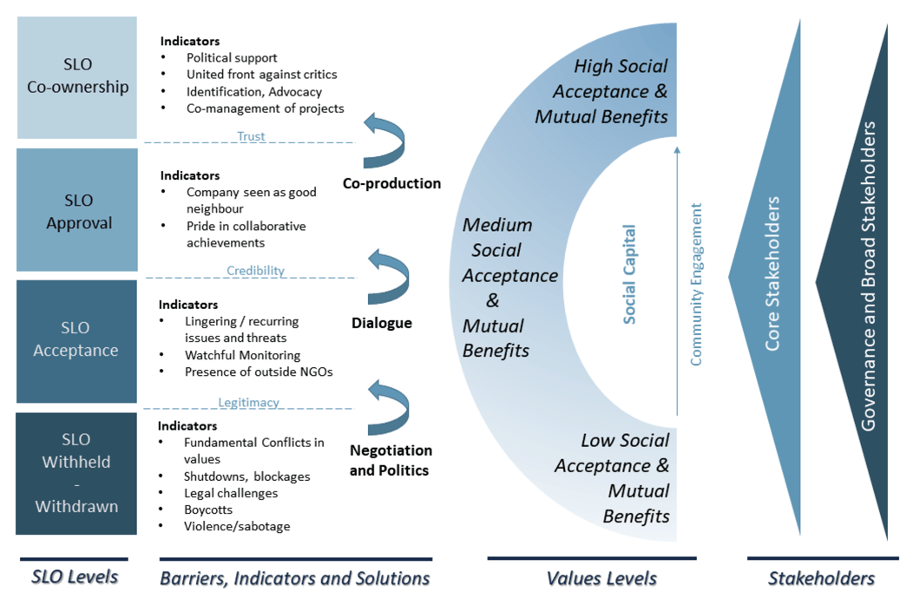
Figure 1: Conceptual framework of social license to operate (SLO) in geothermal energy [14, p. 12]. See text for details.
This paper examines the extent to which the constructs integrated in the SLO model can be empirically proven. Specifically, three main research questions are addressed: the first research question concerns the operationalisation of the variables in the SLO model; here it is assumed that the scales measuring the variables have both a good fit and are significantly related to each other, corresponding to their theoretically assumed role in the SLO model. The second is the prediction of local acceptance using the constructs represented in the model, and the third is the investigation of the factors influencing the identification with the local project in terms of perceived co-ownership as the highest level of SLO.
2. Materials and Methods
In order to examine the approach including relevant factors for the acceptance of geothermal projects, acceptance levels and social impacts connected with geothermal projects within the frame of social license to operate, empirical work was conducted for different case studies. In the following sections, the project background, methodological approach and results are presented in the socio-economic context of Hungary.
Case study: project background and methodological approach
A total of 27 geothermal wells (9 production and 18 injection wells) are being constructed, whereby the supply of 26,338 end users (of the 27,257 total) will be based on renewable energy in the city of Szeged, Hungary. This geothermal energy project, facilitated by the District Heating Company of Szeged, started on September 26th, 2017. Since then, the project has been in constant progress. Nine projects targeting multiple heating circuits have received EU funding and work has either started or will start soon [17].
A total of 27 geothermic well systems are being constructed, servicing 9 heater loops on the basis of renewable energy. With about 96% of end-users affected, it is going to be the second largest geothermal district heating system in Europe following Reykjavik. The potential of and interest in the thermal energy in the area are linked to the fact that the geothermal gradient in the Pannonian Basin is the highest in Europe after Iceland. As space heating is considered a main use of energy by households, it is expected that with the help of deep geothermal energy, a total of nearly 20 million m3 of natural gas will be replaced with 600,000 GJ of geothermal energy per annum, reducing the greenhouse gas load of the city of Szeged by 35,000 tons/year, improving air quality and security of supply. Geothermal energy in the district heating will result in saving 595,887 GJ/year (82%) or 17,525,718 m3/year (68%) of natural gas and will provide 536,298 GJ/year thermal energy in district heating and 34,699 t/year (65%) CO2 emission savings. Furthermore, the geothermal project in Szeged will result in major steps towards Hungary’s independence from gas imports due to the local production of thermal water. The construction started in 2019 and is expected to end towards the end of 2023. In December 2022, there were 4 systems in operation, 2 were being constructed and 3 remained for 2023.
A standardised questionnaire was constructed to capture the various constructs included in the SLO model. Based on theories and results of previous studies [18-20] on the acceptance of renewable energies, the following main scales (Table 1) were integrated. All scales consist of several items addressing the respective scale content and achieved satisfactory (risk perception, 0.74) to very good values (> 0.90) for Cronbach’s alpha (α) as a statistical reliability measure for internal consistency of the questionnaire scales used [21].
Table 1: Overview and characteristics of the scales used in the questionnaire.
| Scale name | Number of Items | Mean value | Standard deviation | Reliability α |
| General acceptance of renewable energy systems (RES) | 5 | 4.64 | 0.68 | 0.95 |
| Local acceptance of geothermal energy | 3 | 4.66 | 0.64 | 0.94 |
| Perception of benefits of geothermal energy | 4 | 4.10 | 0.92 | 0.92 |
| Risk perception | 4 | 2.73 | 0.95 | 0.74 |
| Annoyance perception towards geothermal energy | 3 | 2.43 | 1.02 | 0.82 |
| Trust attribution towards the developing company | 10 | 3.62 | 1.06 | 0.98 |
| Procedural justice perception | 8 | 2.44 | 0.77 | 0.95 |
| Impact on the social structures of the community | 7 | 3.13 | 1.01 | 0.98 |
| Association of the geothermal project with local identity | 4 | 3.13 | 1.13 | 0.96 |
Additionally, aspects, such as conceptual associations with geothermal energy, knowledge gained through the geothermal project, and participation intentions for the future were queried. The complete questionnaire is provided in the Appendix as supplementary material.
The survey was conducted online from June to August 2022 and was supported by the local district heating network company, which forwarded the survey link to residents using also the distribution channels within the customers of the heating network. The usual request for socio-demographic variables to control the sample, such as age and gender, was deliberately omitted to ensure maximum anonymity.
The questionnaire was designed in the national language, Hungarian, and the results were translated into English for publication. All in all, the sample for further analyses consists of 287 respondents.
3. Results
The following section provides the description of the results, following the main research questions of acceptance levels and relevant influencing factors, as well as insights into the constructs used in the SLO approach in connection with the local geothermal project.
3.1. Local acceptance levels
As a first step, the descriptive analyses on the scales used were conducted. Table 2 shows the results for the scale on Local Acceptance. With mean values above 4.5 (in a rating scale range from 1 – totally disagree to 5 – totally agree) for each of the three items (Generally, I support geothermal energy; Geothermal energy should play an important role in future power generation; I would support a geothermal energy project near my home.) it becomes evident that the acceptance level towards the current geothermal project is rather high. The standard deviation for the item “I would support a geothermal energy project near my home” is higher than the two other items, which indicates that there is a certain amount of people with lower support for the local project. Nevertheless, with a mean value of 4.56 it is still on a high level of acceptance.
Table 2: Descriptive results of the scale ‘Local Acceptance of Geothermal Energy’.
| Generally, I support geothermal energy. | Geothermal energy should play an important role in future power generation. | I would support a geothermal energy project near my home. | |
| Responses (n = 287) | 277 | 276 | 275 |
| Mean* | 4.67 | 4.68 | 4.56 |
| Std. Deviation (SD) | 0.66 | 0.66 | 0.85 |
*The Mean value was calculated on the base of a 1-5 Likert rating scale, ranging from 1 – totally disagree to 5 – totally agree.
3.2. Correlation among the relevant influencing factors
With the aim of examining the extent to which the constructs integrated in the SLO model are interrelated, a correlation analysis was conducted. The results in Table 3 show that the individual components correlate highly significantly with each other. Referring to the formulated first research question, perceived risks and annoyances have a negative correlation: the more strongly they are perceived, the lower the level of acceptance. In addition, the analysis provides information about the broader data structure. For example, Trust and Procedural Justice are almost completely correlated at 0.91 (the maximum would be 1 for a perfect correlation), which is an indicator that they can also be considered as one common factor.
Table 3: Correlation matrix of the used main scales.
| Variable | Local Acceptance | RES Acceptance | Benefits | Procedural Justice | Trust | Social Impact | Identity | Risk Perception | ||||||||||||
| 1. Local Acceptance | — | |||||||||||||||||||
| 2. Acceptance RES | 0.75** | — | ||||||||||||||||||
| 3. Benefits | 0.68** | 0.63** | — | |||||||||||||||||
| 4. Procedural Justice | 0.60** | 0.46** | 0.71** | — | ||||||||||||||||
| 5. Trust | 0.56** | 0.46** | 0.67** | 0.91** | — | |||||||||||||||
| 6. Social Impact | 0.47** | 0.44** | 0.70** | 0.79** | 0.76** | — | ||||||||||||||
| 7. Identity | 0.48** | 0.36** | 0.65** | 0.75** | 0.73** | 0.80** | — | |||||||||||||
| 8. Risk Perception | -0.26** | -0.20* | -0.29** | -0.29* | -0.30* | -0.19* | -0.16 | — | ||||||||||||
| 9. Annoyance | -0.43** | -0.34** | -0.46** | -0.52** | -0.52** | -0.41** | -0.45** | 0.44** | ||||||||||||
**Significant at the < 0.001 level. *Significant at the < 0.05 level. RES: Renewable Energy Systems
3.3. Prediction of local acceptance and of integration in the local identity
In order to investigate which of the various factors have the strongest influence on Local Acceptance, a linear regression was performed. The results in Table 4 show the strongest influence for the factors general Acceptance of Renewable Energy Systems (RES) with a standardised regression weight beta of .55 and perception of local Benefits with a beta of .37. The standardised regression weight beta (ꞵ) is normed to the range of -1 to 1; the higher it is the stronger its predictive power.
Table 4: Linear least-squares regression on Local Acceptance.
| Regression model on Local Acceptance | |||||||||||||
| Model | Standard Error |
Standardized ꞵ |
t | p | |||||||||
| (Intercept) | 0.47 | -1.06 | 0.291 | ||||||||||
| RES Acceptance** | 0.10 | 0.55 | 7.41 | < .001 | |||||||||
| Benefits** | 0.08 | 0.37 | 4.09 | < .001 | |||||||||
| Procedural Justice | 0.16 | -0.24 | -1.73 | 0.087 | |||||||||
| Annoyance | 0.05 | -0.00 | -0.13 | 0.890 | |||||||||
| Trust* | 0.11 | 0.30 | 2.23 | 0.028 | |||||||||
Method: Enter. Adj. R2 = 0.78 RMSE =0.41, **Significant on level < 0.001 *Significant on level < 0.05
The results of the regression analysis show that respondents who are convinced about the expansion of renewable energy and also see positive effects, such as value creation or other benefits, are more likely to accept the local geothermal project. Likewise, the factor Trust with a beta of .30 is a significant predictor, which underlines the special role of trust towards the operating company. The other factors did not reach statisticial significance in this test, remaining above the threshold of 0.05.
The result that Procedural Justice has a negative correlation with Local Acceptance (beta of -0.24) is contrary to the theoretical assumption of the positive effect of Procedural Justice on acceptance and also to the results of the correlation analysis (Table 3). This could be a statistical suppressor effect with the Trust variable, as these two scales are very highly correlated with each other (Table 3) [15]. This will be the subject of further analysis.
Following the SLO approach illustrated in Figure 1, the integration into the Local Identity is the highest SLO level in terms of co-ownership and advocacy. Using a linear regression analysis, it was examined which factors influence and statistically predict Local Identity as a dependent variable. The results are shown in Table 5.
Table 5: Results of the linear regression testing the predictive impact on Local Identity.
| Regression model on Local Identity | |||||||||||||
| Model | Standard Error |
Standardized ꞵ |
t | p | |||||||||
| (Intercept) | 0.61 | 0.44 | 0.658 | ||||||||||
| Local Acceptance | 0.16 | 0.10 | 0.81 | 0.416 | |||||||||
| Benefits | 0.18 | -0.00 | -0.00 | 0.993 | |||||||||
| Annoyance | 0.08 | -0.02 | -0.28 | 0.778 | |||||||||
| Procedural Justice | 0.32 | 0.29 | 1.27 | 0.208 | |||||||||
| Trust | 0.19 | 0.03 | 0.18 | 0.854 | |||||||||
| Social Impact* | 0.14 | 0.44 | 2.84 | 0.006 | |||||||||
Method: Enter. Adj. R2 = 0.64 RMSE =0.633 **Significant on a level < 0.001 *Significant on a level <0 .05
The results of the regression analysis shown in Table 5 illustrate that the perception of Social Impacts is the strongest predictor, with a significant beta of .44 and the only factor gaining statistical significance (< 0.05). The scale Social Impacts includes items on the perceived positive effects on community cohesion, neighbourhood connections, or the feeling of belonging and togetherness in the neighbourhood. Thus, this result underlines that the more a geothermal project contributes to social benefits, the more it is perceived to be part of the community’s self-image and the more strongly people integrate it in the community’s identity.
4. Discussion
The results show that the local acceptance of the geothermal project in the case study under investigation is on a high level, which is not a matter of course for a geothermal project of this size. In the last two years, many boreholes have been drilled, causing at least temporary inconvenience to local residents. Apparently, the accompanying information and communication measures by the operating company have had a positive effect, so that in the end a positive local attitude toward the project prevails.
Regarding the influencing factors statistically predicting local acceptance in the conducted regression analysis, in particular the assumed support of renewable energy as a general attitude and the locally perceived benefits are the most important predictors (shown by Table 3). This finding is in line with the results of other studies in the field of renewable energy [23–25] and shows that a multi-level strategy is necessary for the acceptable design of renewable energy deployment. On the one hand, the big picture about the goals and background of the energy transition and the role of the individual renewable technologies must be drawn and adequately communicated so that it is comprehensible and understandable to the public. Additionally, visible benefits need to be created locally for the directly affected residents, on the other hand. These benefits need not only to be of an economic or material nature, but can also manifest themselves in positive effects on the social structure of the community.
In this respect, the analyses on identity have shown that for the perceived connection and local integration of the project, the perceived social impacts, such as positive effects on social cohesion, are the most important factor. This shows the added value of the holistic SLO approach, which also includes these aspects and represents a significant advantage as an explanatory approach and monitoring tool in terms of decentralization, opportunities for participation and developments over time.
Regarding a methodological reflection on the all in all very positive perceptions of geothermal energy within the sample, it is fair to consider that this might be connected to the increased salience of the topic energy due to the war Russia started against Ukraine in February 2022. As the data collection took place in summer 2022, it can be assumed that the awareness within the population regarding the importance of independence from Russian gas for the security of supply had risen, thus a positive impact towards the acceptance of local energy projects seems reasonable.
In addition to the scientific results presented above, the SLO concept can play a role when it comes to practical implementation of geothermal projects. The SLO concept and the corresponding standardised protocol can be used with different functions in the project-related phases, ranging from the early project definition till decommissioning and post-closure, throughout the whole life cycle of the project [26].

Figure 2: Measuring acceptance of SLO in different project phases [26]. See text for details.
A protocol containing questions about the SLO components can have several functions, such as in the planning phase to query concerns and needs, existing expectations and fears a priori (Figure 2). Based on the results, adequate communication strategies can be derived. During further project development phases (exploration, drilling, construction, operation and decommissioning) the protocol can be used as a monitoring tool to make undesirable developments and dissatisfactions visible. In addition, it can be actively used as a participation tool by using the results as a basis for joint discussions and reflections with the local population and stakeholders, therefore enriching existing participation formats such as workshops or roundtables. Finally, it offers the function of evaluation and proof of impact, measuring to what extent the central SLO criteria have been achieved and a social license to operate exists. In this way, the SLO approach can be used continuously over longer periods of time.
5. Conclusions
The presented study provides valuable insights into the nature of social acceptance on local level and its relationship with components of the Social License to Operate approach such as local identity, social impacts and trust. For future research, it would be important to conduct further studies using the presented standardised questionnaire in different case studies and at several measurement points in time, so that the comparisons enable a robust statement on the interrelationships of effects and variables used. Thus, the knowledge about the nature of SLO factors connected to geothermal projects can be deepened and enriched.
Author Contributions: Conceptualization, J.H.; methodology, J.H., A.J., L.S..; validation, J.H., A.J., L.S. and A.B.; formal analysis, J.H..; investigation, J.H., A.J.; writing—original draft preparation, J.H..; writing—review and editing, J.H., A.J., L.S. and A.B..; visualization, J.H., A.J. All authors have read and agreed to the published version of the manuscript.
Funding: This research was funded by EU Horizon 2020 Programme, CROWDTHERMAL project, Grant Agreement number 857830.
Acknowledgments: We sincerely thank Dr. Tamás Medgyes and his colleagues for supporting the data collection in Szeged.
Conflicts of Interest: The authors declare no conflict of interest.
References
- Batel, S. Research on the social acceptance of renewable energy technologies: Past, present and future. Energy Research & Social Science 2020; 68:101544. https://doi.org/10.1016/j.erss.2020.101544.
- Ejderyan, O.; Ruef, F.; Stauffacher, M. Entanglement of Top-Down and Bottom-Up: Socio-technical Innovation Pathways of Geothermal Energy in Switzerland. The Journal of Environment & Development 2020, 29 (1), 99–122. https://doi.org/10.1177/1070496519886008
- Carr-Cornish, S.; Romanach, L. Differences in Public Perceptions of Geothermal Energy Technology in Australia. Energies 2014, 7(3), 1555–1575. https://doi.org/10.3390/en7031555
- Vargas Payera, S. Understanding social acceptance of geothermal energy: Case study for Araucanía region, Chile. Geothermics 2018, 72, 138–144. https://doi.org/10.1016/j.geothermics.2017.10.014
- Vargas-Payera, S.; Martínez-Reyes, A.; & Ejderyan, O. Factors and dynamics of the social perception of geothermal energy: Case study of the Tolhuaca exploration project in Chile. Geothermics 2020, 88, art. no. 101907. https://doi.org/10.1016/j.geothermics.2020.101907
- Balzan-Alzate, D.; López-Sánchez, J.; Blessent, D. et al. An online survey to explore the awareness and acceptance of geothermal energy among an educated segment of the population in five European and American countries. Geotherm Energy 2021, 9, 9. https://doi.org/10.1186/s40517-021-00188-x
- Stauffacher, M.; Muggli, N.; Scolobig, A.; Moser, C. Framing deep geothermal energy in mass media: The case of Switzerland. Technological Forecasting and Social Change 2015, 98, 60–70. https://doi.org/10.1016/j.techfore.2015.05.018
- Dowd, A.-M.; Boughen, N.; Ashworth, P.; Carr-Cornish, S. Geothermal Technology in Australia: Investigating Social Acceptance. Energy Policy 2011, 39, 6301–6307, doi:10.1016/j.enpol.2011.07.029.
- Zaunbrecher, B. S.; Kluge, J.; Ziefle, M. Exploring Mental Models of Geothermal Energy among Laypeople in Germany as Hidden Drivers for Acceptance. Journal of Sustainable Development of Energy, Water and Environment Systems 2018, 6(3), 446–463. https://doi.org/10.13044/j.sdewes.d5.0192
- Wüstenhagen, R.; Wolsink, M.; Bürer, M.J. Social Acceptance of Renewable Energy Innovation: An Introduction to the Concept. Energy Policy 2007, 35, 2683–2691, doi:10.1016/j.enpol.2006.12.001.
- Ellis, G.; Ferraro, G. The social acceptance of wind energy; EUR 28182 EN 2016, doi 10.2789/696070
- Ruef, F.; Stauffacher, M.; Ejderyan, O. Blind spots of participation: How differently do geothermal energy managers and residents understand participation?. Energy Reports 2020, 6, 1950-1962. https://doi.org/10.1016/j.egyr.2020.07.003
- Rowe, G.; Frewer, L. J. A typology of public participation mechanisms. Science, Technology and Human Values 2005, 30, 251-290.
- Barich, A.; Stokłosa, A.W.; Hildebrand, J.; Elíasson, O.; Medgyes, T.; Quinonez, G.; Casillas, A.C.; Fernandez, I. Social License to Operate in Geothermal Energy. Energies 2022, 15, 139. https://doi.org/10.3390/en15010139
- Devine-Wright P. Rethinking NIMBYism: The role of place attachment and place identity in explaining place-protective action. J. Community. Appl. Soc. Psychol. 2009; 19(6):426–41. https://doi.org/10.1002/casp.1004.
- Knudsen, J.K.; Wold, L.C.; Aas, Ø.; Haug, J.J.K.; Batel, S.; Devine-Wright, P.; Qvenild, M.; Jacobsen, G.B. Local perceptions of opportunities for engagement and procedural justice in electricity transmission grid projects in Norway and the UK, Land Use Policy 2015, 48, 299-308. https://doi.org/10.1016/j.landusepol.2015.04.031
- De Gregorio, M.; Perez, P.; Casillas, A. Case Study Assessment Protocol, CROWDTHERMAL Deliverable 5.1; CROWDTHERMAL: Brussels, Belgium, 2020.
- Sonnberger, M.; Ruddat, M. Local and socio-political acceptance of wind farms in Germany. Technology in Society 2017, 51:56–65. https://doi.org/10.1016/j.techsoc.2017.07.005.
- Zoellner, J.; Schweizer-Ries, P.; Wemheuer, C. Public acceptance of renewable energies: Results from case studies in Germany. Journal of Energy Policy 2008, 36 (11), S. 4136-4141. https://doi.org/10.1016/j.enpol.2008.06.026
- Warren, C. R.; McFadyen, M. Does community ownership affect public attitudes to wind energy? A case study from south-west Scotland. Journal of Land Use Policy 2010, 27, S. 204–213. https://doi.org/10.1016/j.landusepol.2008.12.010
- Bortz, J.; Döring, N. Forschungsmethoden und Evaluation für Human- und Sozialwissenschaftler (4. ) (Research Methods and Evaluation for Scholars in the Humanities and Social Sciences, 4th ed.). Berlin: Springer. 2006
- Kim, Y. The causal structure of suppressor variables. Journal of Educational and Behavioral Statistics 2019, art. no. 1076998619825679. https://doi.org/10.3102/1076998619825679
- Walter, G. Determining the local acceptance of wind energy projects in Switzerland: The importance of general attitudes and project characteristics. Energy Research & Social Science 2014, 4, 78–88. https://doi.org/10.1016/j.erss.2014.09.003
- Larson, E. C.; Krannich, R. S. “A Great Idea, Just Not Near Me!” Understanding Public Attitudes About Renewable Energy Facilities. Society & Natural Resources 2016, 29(12), 1436–1451. https://doi.org/10.1080/08941920.2016.1150536
- Batel, S.; Devine-Wright, P. Towards a better understanding of people’s responses to renewable energy technologies: Insights from Social Representations Theory. Public Understanding of Science 2015, 24(3), 311-325. https://doi.org/10.1177/0963662513514165
- Baisch, C.; Wolpert, P.; Friederichs, G.; Kraml, M. Alternative Finance Risk Inventory, CROWDTHERMAL Deliverable 3.2: CROWDTHERMAL: Brussels, Belgium, 2020.
This article has been published in European Geologist Journal 54 – Geothermal energy – A geological contribution to the energy transition
Read here the full issue:
