
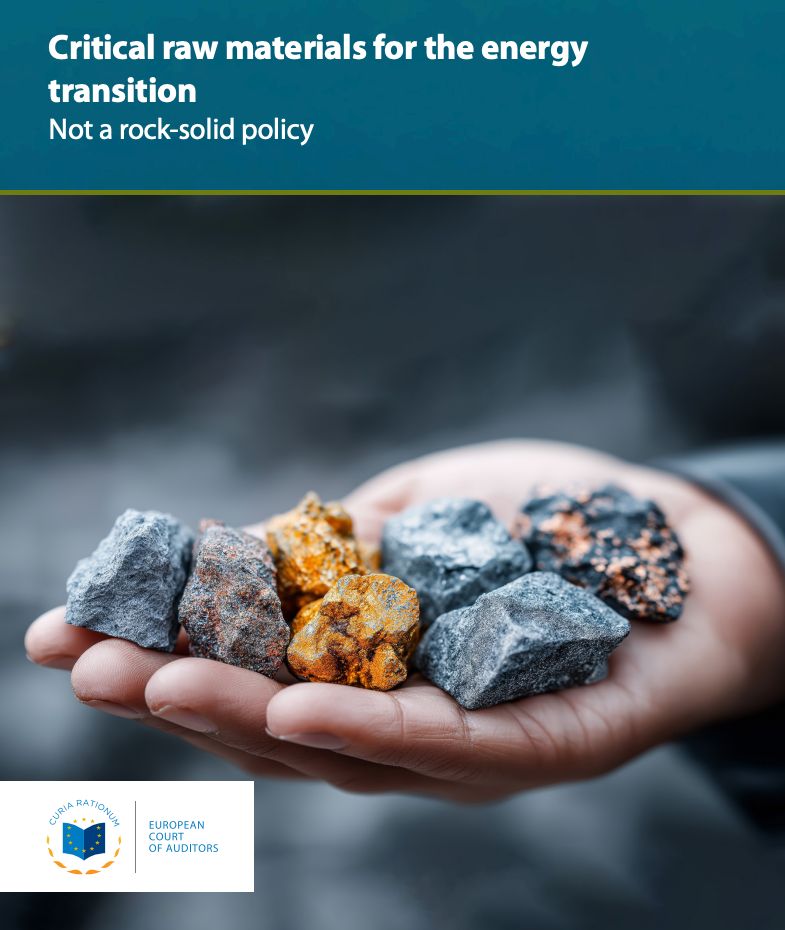
The European Federation of Geologists (EFG) has published a position paper on the 2025 RESourceEU action plan, warning that the European Union’s approach to securing critical raw materials (CRM) for the energy transition remains fundamentally weakened by the insufficient integration of geological expertise. These concerns have now been echoed by the European Court of Auditors’ Special Report 04/2026, which identifies insufficient exploration and incomplete geological baseline knowledge as major bottlenecks for increasing Europe’s domestic supply of critical raw materials.
While RESourceEU focuses on industrial resilience, supply chains, and permitting, both EFG and the Court of Auditors highlight a more fundamental reality: without exploration, there can be no pipeline of projects, and without robust geological data, Europe cannot realistically meet its 2030 objectives.
The Court’s report confirms several long-standing concerns raised by EFG. Europe lacks a sufficient pipeline of exploration projects, meaning that without sustained and coordinated efforts today, future mining and processing projects cannot materialise within the EU’s strategic timelines. Incomplete geological mapping and fragmented data across Member States continue to hinder the identification of new deposits, underlining the need for harmonised, pan-European geological data systems. Early-stage exploration also remains underfinanced and high-risk, discouraging the private investment needed to move projects from concept to development.
EFG emphasises that addressing these challenges requires the systematic involvement of qualified and certified professional geoscientists, such as holders of the European Geologist (EurGeol) title. Professional geoscientists are essential for designing exploration programmes, interpreting subsurface data, and reducing geological, environmental, and financial risks at an early stage. Certified professionals operating under recognised technical and ethical standards also strengthen the credibility of projects and increase societal acceptance.
In light of the RESourceEU action plan and the findings of the European Court of Auditors, EFG calls on EU institutions and Member States to embed geological expertise in governance, make geological competence a regulatory requirement in permitting procedures and industrial risk assessments, and launch an EU-wide strategic initiative to build and sustain Europe’s geoscience talent pipeline.
As confirmed by the European Court of Auditors, geological knowledge and expertise are not optional add-ons. They are prerequisites for Europe’s raw materials security and strategic autonomy.
Read the full EFG press release here: https://eurogeologists.eu/go/2026-press-release-crm
